
Perhaps you’ve noticed something beautiful since you retired – a quietness, a spaciousness you haven’t felt in decades. Mornings that unfold without urgency, afternoons that belong entirely to you, and in that beautiful space, a question is emerging: “Who am I now?”
Not what should I do with my time, but genuinely… who am I when I finally have space to discover?
I’ve been working with women like you for thirty-three years now – women who spent their careers as nurses, teachers, coordinators, women from caring and analytical professions who were brilliant at what they did. And now you’re asking something wonderful: what about me? Who am I becoming?
That’s not selfish, you know. That’s the beginning of something beautiful.
The spaciousness
You know what I’ve noticed? When women retire from caring professions, something opens up – this space, this beautiful unfamiliar space where you can finally wonder and explore and be curious about parts of yourself you set aside all those years.
And in that space, something starts to stir. The creative part of you that’s been waiting, patient and preserved and quietly present all along. The part you set aside when life called you toward practicality and responsibility, the part that’s whispering now: what if it’s my turn? What if there’s more to discover?
What if you’ve been creative all along?
Here’s something wonderful I want you to consider – what if “I’m not creative” was never actually true?
You spent your career being observant, detail-oriented, able to see what others missed. You could assess a situation at a glance, notice patterns, understand how things related to each other in space, and you made hundreds of observations every single day. That’s creativity, you know. You just expressed it through nursing, or teaching, or coordinating.
But those same skills – observation, pattern recognition, spatial awareness, attention to detail – they’re exactly what drawing is. You don’t lack creative ability, you’ve just never applied these skills you already have to paper with a pencil in your hand.
What if that’s all it takes? What if you’ve had this capacity all along, just waiting for the right moment to express it in a new way?
Drawing as the carriage
Here’s something I’ve discovered about this work over all these years – the drawing itself is just the carriage, the vehicle that carries you somewhere beautiful, to discovering who you’re becoming.
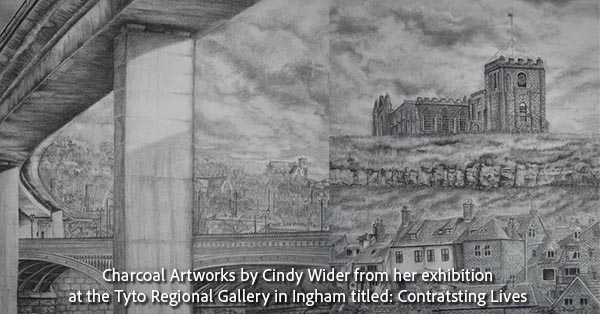
Because when you sit at your table with a charcoal pencil in your hand, something lovely happens. It’s your time, completely yours, a quiet space where you’re simply being and creating and discovering. And gently, through practice, you begin to hear a voice you haven’t heard in such a long time – your own creative voice, the one that says: I am creative, I always was, look what I can do.
The women I’ve worked with
Mary Egan was a Director of Nursing in Ireland, and at seventy she discovered something beautiful. She told me: “Never in my wildest dreams did I expect to be illustrating my own children’s book, which was a lifetime dream.” A lifetime dream at seventy, discovered and brought to life.
Lynn Donald from right here in Queensland said: “Cindy changed my life, not for a year or two, but a lifetime.” Can you imagine that? A lifetime of creative identity, waiting to be claimed.
And Linda Elliott, who’d worked in management for decades, told me: “You gave me the confidence to call myself an artist.” These women spent decades being analytical, practical, brilliant at what they did, and then they discovered something wonderful – their analytical minds weren’t preventing creativity, they were the pathway to it.
When things come together
What happens during this transformation is something quite beautiful to witness. You begin gently with loose marks and expressive movements, permission to explore and play without any pressure at all. Then gradually, structure arrives – systematic techniques, clear steps, building blocks that make perfect sense to your analytical mind.
And somewhere in that process, something remarkable occurs. The creative spirit and the analytical mind, they meet and begin working together in this beautiful harmony. Those observational skills you developed over forty years become your drawing foundation, the attention to detail that made you excellent at your work becomes artistic precision, and the systematic thinking that served you throughout your career becomes your pathway to mastery.
You realize: I’m not just making marks, I’m creating something beautiful, something real, something that’s coming from me.
The moment of recognition
There comes a moment in this journey, and it’s different for every woman but it always comes – the moment when you look at something you’ve created and think: I created this, I actually did this.
That’s when everything shifts, not because you became something new, but because you recognized what was always there. You have proof now, beautiful tangible proof created by your own hands, and suddenly the answer to “Who am I?” expands in the most wonderful way.
I am an artist, I am creative, this was here all along. Not a hobby, not just something to fill time, but an identity, a discovery, a homecoming to a part of yourself that’s been patiently waiting.
Your turn
For forty years, you facilitated other people’s learning and healing and growth and creativity. You were brilliant at what you did – the nurse who brought calm, the teacher who unlocked potential, the coordinator who made everything flow. You helped so many people discover their own capacities.
And now? It’s your turn to discover yours. Your turn to create and explore and prove to yourself that this creative capacity was always there, just waiting, patient and preserved, ready for exactly this moment when you finally have space to say: yes, now, me.
The beautiful question
Who am I now?
Perhaps the answer is found in curiosity, in the gentle stroke of charcoal on paper, in the quiet discovery that you’ve always had this capacity within you. In the beautiful realization that your analytical mind and creative spirit were never opposites at all – they were always meant to work together.
And when they finally do? You don’t become someone new. You discover who you’ve always been – complete, creative, capable of beautiful things.
Warmly,
Cindy
Related Articles
Everything You’ve Been Told About Creativity and Analytical Minds Is Wrong
Related Articles and Extra Reading
Meet my clients and read about their journey
Examples of Before and After Client progression
You can Learn to Draw in 60 Seconds