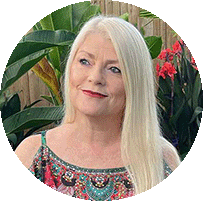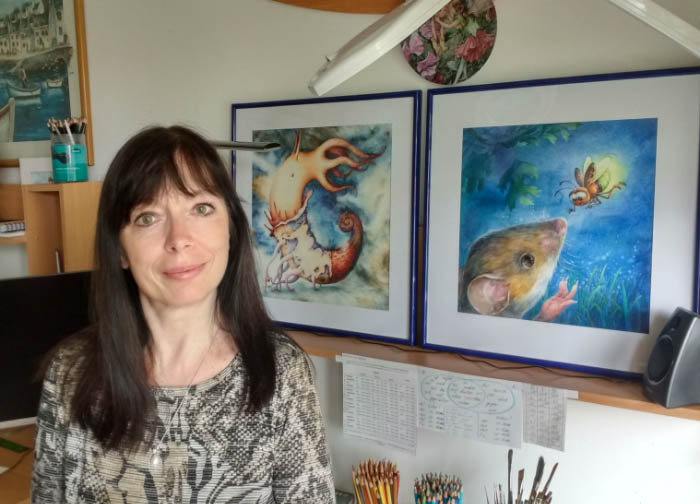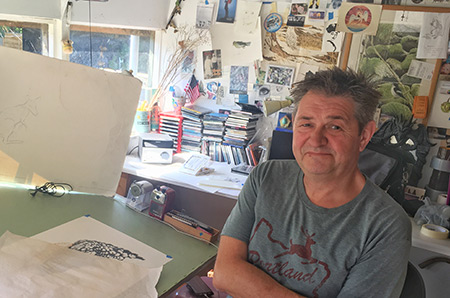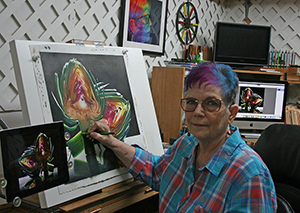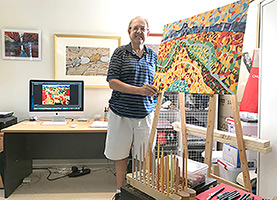

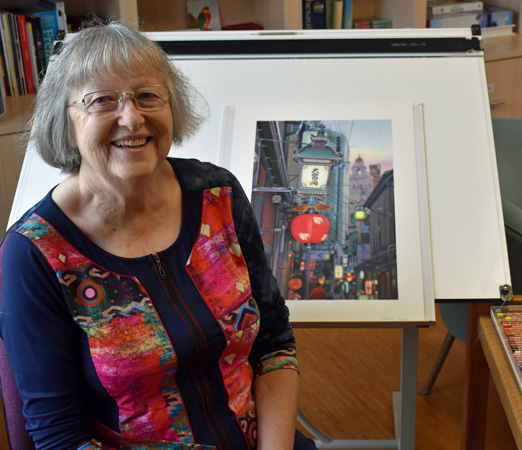
Coloured pencil artist Julie Podstolski in her studio
Julie Podstolski is an inspirational coloured pencil master. A true pioneer of the medium, using coloured pencil for her professional gallery-selling multi-award winning artworks since 1989. Another revolutionary artist who has paved the way for this medium to be truly recognised as a respected medium for high end artworks, selling in exhibitions and galleries. Let me introduce you to the artist and her body of work through this interview.
Julie began working in oils during her art school years, but soon after her third daughter Lucy came into her life, she realised the frustration of juggling wet paint with new motherhood. She went out and bought pencils and paper and never looked back. Julie works in the gorgeous medium of coloured pencil.
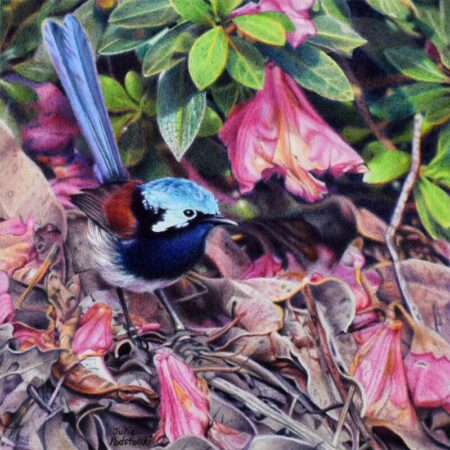
Who Goes There? 22cm (W) x 22cm (H) Coloured pencils on Arches Aquarelle smooth
Since 1989, she has held 18 exhibitions across Sydney, New Zealand and Western Australia, exploring subjects ranging from landscapes and cityscapes to Kyoto geisha, Paris, Venice, birds and light. She has also developed her own signature style she calls “coloured pencil impressionism.” Her work has been recognised with numerous awards, though today she finds presenting a complete body of work far more rewarding.
The following quotes perfectly summarises Julie’s dedication and love for art, in her own words, “Art is my friend and companion. The profound joy of observation and then recreating my vision with coloured pencils is my recipe for a fulfilled life. I can’t NOT do it because if I have a break from drawing I get lost and depressed. It is necessary for my equilibrium and mental health. I do love to observe what is around me and art is my response to life’s curiosities.”
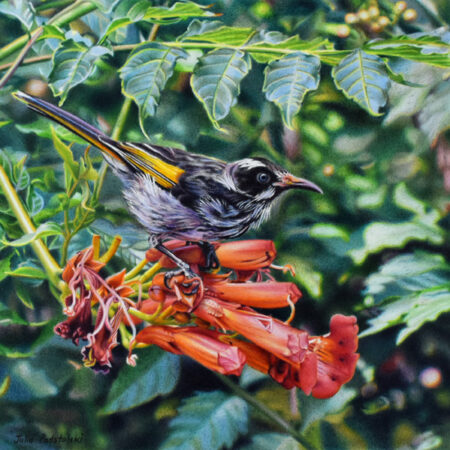
Fun on the Trumpet Vine Coloured Pencils 28 x 28 cm
Interview with Julie Podstolski by Cindy Wider
Q: Please tell us your preferred art name year of birth and Country of origin
A: My art name is Julie Podstolski. Podstolski is my maiden name and the name I have kept for art all my life. (In other walks of life I use my married name Julie Clements.) I was born in Wellington, New Zealand, in 1959. I am the youngest of three. My father was Polish and my mother, English. They met in a Nottingham dance hall during the second world war. I get my art genes from my father. In 1982 my then boyfriend, Matthew, (now husband) and I moved from New Zealand to Australia. Matt and I have three daughters who all work in the arts.
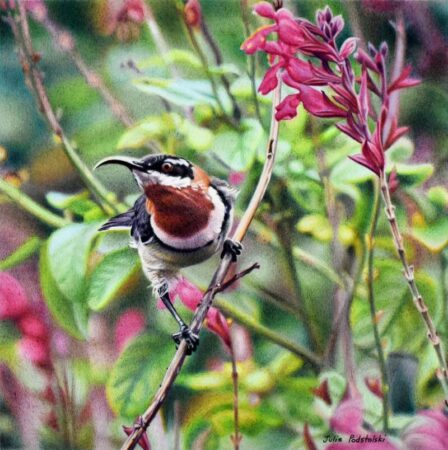
Private Universe Coloured pencils on Arches Aquarelle hot-pressed 28cm (W) x 280cm (H)
Q: Julie could you tell us when you first realised that you enjoyed creating art as a child and you were supported in your decision, if so by who?
A: I always loved drawing. Even from toddler age I scribbled in books (very naughty) and drew on our kitchen cupboard door with crayon. (I liked the sound of crayon tapping on wood. I was pretending to be the weatherman on TV drawing in the frontal systems.) There were always art materials and paper in our house. I drew for hours at a time in my primary years making up stories as I drew – princess stories, boarding school stories (including designing the uniforms) and riding school stories – noting each horse and pony’s name, colour and vital statistics. Even though I got my art talent from Dad, my mother was very kind, taking me to Wellington’s main art gallery – where she used to wonder how a child could take such an interest in paintings. Mum bought me lots of art supplies including my first full set of 72 Derwent coloured pencils when I was at high school.
Seeking the Sublime coloured pencil & Neocolor II pastels 46 x 30.5 cm
Q: What journey have you been on as an artist?
A: It was a foregone conclusion that I would choose the art stream at high school. I attended Wellington Girls’ College. I received the art prize in third form, fourth form and seventh form. After college I was accepted into The School of Fine Arts at Canterbury University, Christchurch, where I studied for three years, majoring in painting. Back then the course was a diploma – so I have a Diploma of Fine Arts from Canterbury University. I’m very glad I went to art school though I struggled at times as I was a realist art student in a time of abstract expressionism.
At art school one of my tutors steered me towards photorealism as it was the late 70s, and if I was going to do realism, he said, it might as well be photorealism which was at that time in vogue. I learnt so much at art school including classes in life drawing, photography, three-dimensional studies, colour theory, art history, perspective, composition – and painting, my major. Art school pushed my boundaries and forced me to problem-solve.
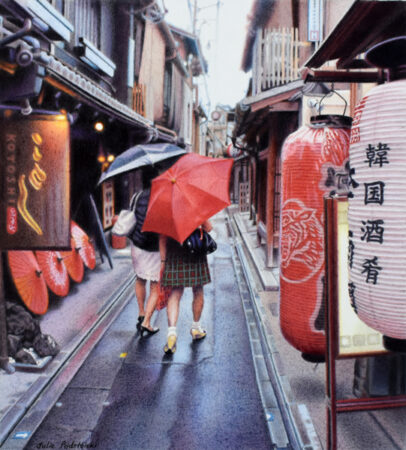
Red on a Grey Day coloured pencils 31 x 28 cm
Q: What is the primary motivation for why you create art?
A: Art is a vocation for me; a calling (like going into a religious order). I can’t NOT do it because if I have a break from drawing I get lost and depressed. It is necessary for my equilibrium and mental health. I do love to observe what is around me and art is my response to life’s curiosities.
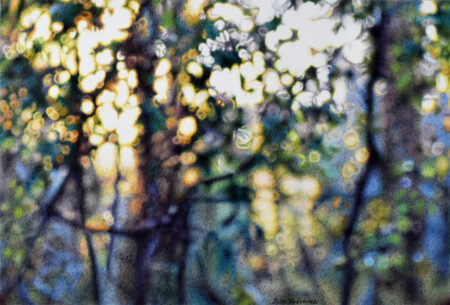
Transcendence coloured pencils 28 x 41 cm
Q: What goes through your mind while you draw/paint, is there a calm silence, do you listen to music or do you experience doubt, fear or any emotions at all?
A: When I am making art I go through multiple states of mind. From being ‘in the zone’ and absorbed, to being bored (yes, sometimes it can be tedious) to intense enjoyment, intense frustration, doubt and fear.
I go into new pieces not knowing if I will be able to pull them off but questioning whether I can. And that is the fun of it; will I or won’t I succeed and how will I pull it off if I do? I like to challenge myself. When something is nearing the end and does not seem to be working, then I pull out all the stops, risking everything. In other words I am prepared at this stage to kill it or cure it. And most of the time I cure it.
While I work I like to listen to podcasts, music or Radio National. But when I am composing, I need silence. I must be using a different part of my brain then – such as when I’m writing I also need silence.
I must also mention that drawing can be a type of self-nurturing. Recently my husband had surgery and needed a lot of care once he got home. It was a nerve-wracking time being a nurse and hoping that I was doing the right thing. During these few weeks I was working on a drawing and it gave me respite from worry.
My husband also felt the calm state radiating from the drawing desk. Art can perform so many roles, everything from the heady creative thrill to the comfort of a dear old friend.
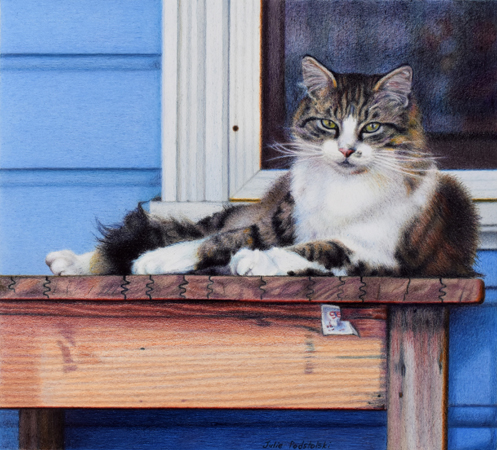
Himself coloured pencils 29 x 32 cm
Q: What is your favourite medium to work with and why? Please tell us your favourite brands of these mediums.
A: It is essential for me to work with non-fading colours as I sell my art so I can’t have it disappearing on my clients’ walls. I therefore use primarily Caran d’Ache Luminance 6901 lightfast coloured pencils. These are my main tools. I also use Derwent Lightfast coloured pencils and a few Faber Castell Polychromos but more than 90% of each drawing is with Luminance. My favourite white is a Japanese brand – Holbein Soft White.
I have been using coloured pencils in earnest since the mid-90s so have therefore seen some significant fading over the years – as truly lightfast coloured pencils hadn’t been invented back then. I bought my first Luminance pencils when they became available in 2009. I was delighted when they increased their range from 76 to 100 colours and when Derwent brought out its own lightfast range.
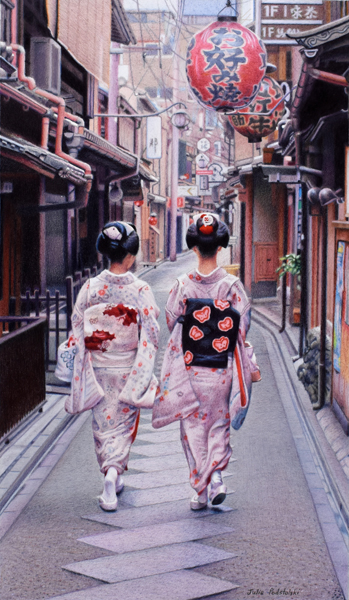
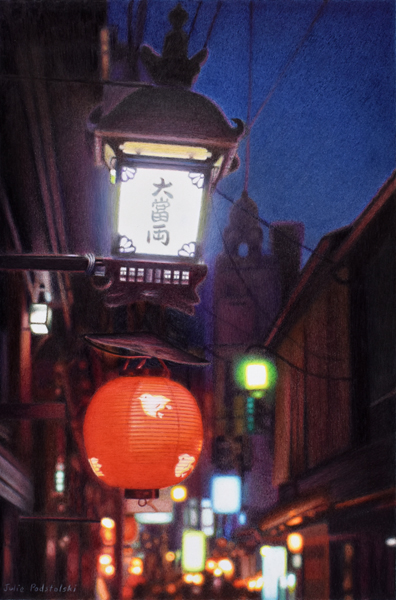
Pontocho Perfect coloured pencils 46.5 x 27 cm
Q: How do you make time to include art in your life, do you have any suggestions to help others manage their creative lives?
A: The great thing about coloured pencils is that they can be put down and picked up any time. When I was younger I was primarily an oil painter. The reason I switched to coloured pencils was that I had my third baby and oils became too difficult to use. I’d just mix up a colour after putting the baby in her cot and then she would cry and I’d have to stop painting immediately.
It was hopeless. I had a brainwave to try coloured pencils instead. They saved me!
I don’t have to think too much about making time for drawing as it is the thing I most want to be doing. Often I will get up in the morning and go straight to my art desk to do a couple of hours of drawing before getting on with the rest of my day. Making the time to exercise, do housework, cook and socialize is more perplexing for me.

Most Serene coloured pencil & Neocolor II pastels 33.5 x 48.5 cm
Q: Is Drawing and creating artworks your only profession or main business. If not, what else do you do for work?
A: My profession is to make art. I have exhibitions every couple of years. This year is unusual as I will be exhibiting only 13 months after my last exhibition. Usually I exhibit no more than every 24 months.
As well as making art I work as a volunteer twice per week at singing groups for people living with dementia and their carers. I don’t sing but help with the administration, afternoon tea and projection of lyrics. I love helping as it is such a nice change from being quiet at home. It is great to be part of a team of volunteers.
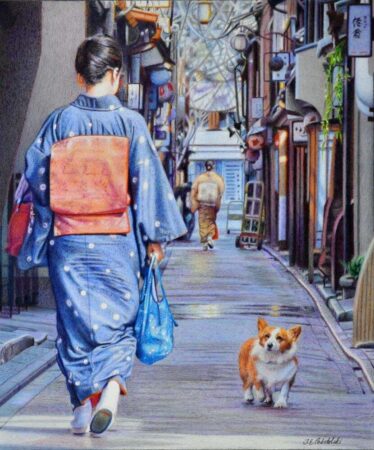
Encounter 40cm (W) x 33.5cm (H) Coloured pencils on Arches Aquarelle hot-pressed paper
Q: Do you have any special unique advice or skills to share with other artists who are learning to create artworks at this very high standard that you are working at? Are you willing to share any skills with others?
A: I must admit to having no teaching skills! After art school I went to teachers’ training college with the aim of being a secondary school art teacher. But I couldn’t bear the idea once I got there and left after two weeks. I share a few of my art methods on my blog but I leave it to other artists to do workshops and teach. I took a weekend workshop at Fremantle Arts Centre in 2004 – and just like at teachers’ training college, I couldn’t get out of there fast enough!
When people come to my exhibitions they ask many questions about techniques and I try to answer as best as I can. I will say that the more you can learn about colour theory the better. Using coloured pencils means mixing and blending right on the paper. You need to learn what plus what equals what.
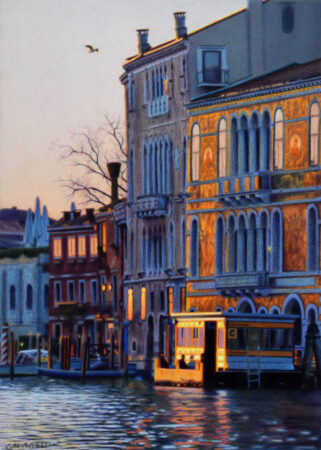
Morning Has Broken coloured pencils 40.5 x 29 cm
Q: What major and significant goals have you achieved with your art?
A: Probably the best award I’ve won is “Best in Show” in Colored Pencil Society of America “ExploreThis” (an annual award for coloured pencils with another medium) in 2015. I have won a few awards in the CPSA shows and quite a few over the years in Perth community art awards. I don’t go into the community awards these days as I’d rather put my effort into my own exhibitions. Having a whole body of work thoughtfully curated and lit in a gallery space is more satisfying to me than going in competitions. I have had articles on my work in various coloured pencil magazines. (Many of my art awards are listed on my curriculum vitae on my blog.)
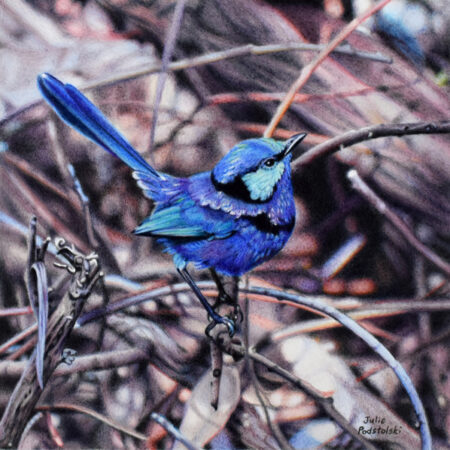
Blue Beauty Coloured pencils 22 x 22 cm
Q: What major and significant goals and influences do you have for your art if any? Tell us who or what inspires you to be the best you can be as an artist.
A: At 66 years old I don’t have any more significant goals I’m working towards other than drawing one piece at a time and making it work as well as I can. I am proud of my lifetime’s body of work. My website is a visual library of decades of art going right back to art school in the late 70s. I also have a blog which I began in 2013. My blog is full of drawings, paintings, photography and ideas – and occasionally a sharing of methods.
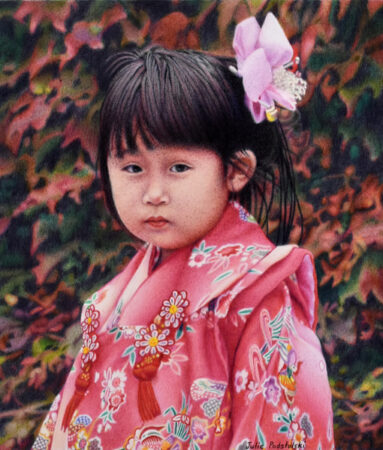
Little One coloured pencils 34 x 29 cm
Q: Is there anything else that you would like to tell me about your art journey so far?
A: Art is part of my curiosity for life. I love to walk with my camera; observing, exploring. Different subjects I have concentrated on at various times have been New Zealand and Australian landscapes and city-scapes, Kyoto (including geisha), Paris, Venice, street art, what I call “coloured pencil impressionism” (everything soft focus), birds and the quality of light.
When I am out with my camera I don’t always know what I am looking for but I know when I find it. So much of my art has been to do with travel and a love of history. When I become immersed in a subject then I want to know all about it which means copious reading and learning.
In the time of Covid-19 when our borders shut and I couldn’t travel I discovered the glory and joy of our local birds. These days I’m a bit over travel as I can’t be bothered with all the crowds. My favourite thing is to take my camera to a botanic park in Perth’s hills called Araluen Botanic Park where I look for and photograph our tiny bush birds. Each bird I draw is not a stereotype, but an individual. I try to capture his unique personality. (Usually ‘his’ as males are so often more colourful than females.)
One more thing – I see a composition as a whole. I don’t believe in ‘a main subject’ and a ‘background’. To me a work is conceived as one integrated piece – all working together in harmony.
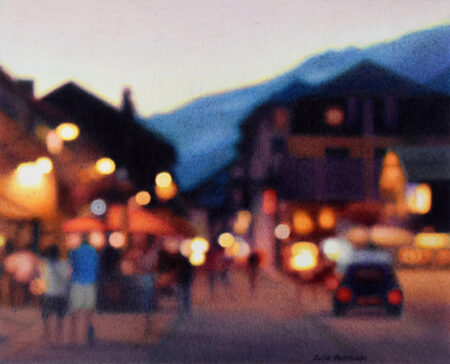
Another Time coloured pencil & Neocolor II pastels 25 x 31 cm
How to contact Julie:
To see more from Julie Podstolski check out her work at the link below
Podcast Interview: Cindy Wider with Julie Podstolski https://youtu.be/KxLlWDFmDpU
- Website: www.juliepodstolski.com
- Blog: https://juliepodstolski.wordpress.com/
- Email: juliepodstolski@gmail.com
- Facebook: www.facebook.com/JuliePodstolski/
- Instagram: @juliepodstolski